
Effective Time Management: How to Get Things Done When Everything Important Was Yesterday

Everyone has 24 hours, but for some, that day fits a project, exercise, and family, while for others, it's all about fatigue and "I didn't get anything done." The difference isn't in discipline or a "magic method": it's in a system that protects attention from other people's priorities. The team atLemag.kzhas put together a working time management framework for 2026—without 40-line spreadsheets or guilt, and with concrete steps for the week. ## 1. Why To-Do Lists Don't Work
A classic to-do list is a graveyard of intentions. The brain sees 12 items without a time or address and makes the only reasonable conclusion: "It's impossible" - and puts everything off. The second trap isplanning error: we systematically underestimate the time for tasks by 1.5-2 times, so even an honest list is bursting at the seams by lunchtime.
- List without calendar = wish-list;
- 10 tasks a day = guaranteed stress;
- "urgent" always supersedes "important" unless important is protected by a slot.
Time management is not about “getting everything done.” It’s about making sure that the important things don’t die under the weight of the unimportant.
2. Audit: Where the Day Really Goes
Before you treat time, measure it. A week of honest tracking gives more than any technique.
- For three days, record everything to the nearest 15 minutes (or turn on the autotracker);
- divide into three buckets: focus(deep work), routine(mail, chats, meetings), leaks(feeds, “stickiness”);
- calculate the share of focus - for most it is 1–2 hours with the feeling of “working all day.”
The purpose of the system is not to add hours, but to transfer time from leaks and part of the routine into focus.
3. One priority task: the MIT method
MIT (Most Important Task)- one task after which the day is considered successful, even if the rest is wasted. The formula for choosing: “if I only do this tomorrow, the week is not a failure.”
- Choose MITin the evening, and not in the morning: morning is the time to execute, not to decide;
- put MIT on the first working slot while your will and brain are fresh;
- secondary tasks - no more than two.
4. Time blocking: calendar instead of list
A task without a slot is a dream; a task with a slot is a plan. Time blocking turns a list into a schedule:
- Focus block 90 minutesunder MIT - in the morning, phone in another room;
- Routine blocks2 x 45 minutes: email, chats, calls - processed in batches, not in the background;
- buffer 20%of the day empty: force majeure must take place, otherwise the entire schedule collapses;
- recovery unit: Lunch without a screen and a walk are also working slots.
Color the blocks three colors: focus (orange), routine (gray), and recovery (green). The week on the calendar should look like a balanced palette, not a solid gray: this is the best visual indicator of overload. :::
Color the blocks three colors: focus (orange), routine (gray), and recovery (green). The week on the calendar should look like a balanced palette, not a solid gray: this is the best visual indicator of overload.
 ## 5. Pomodoro 2.0 and Ultradian Rhythms
The classic 25/5 is good for starting, but deep work requires long waves: the brain reaches peak concentration by the 15-20th minute, and the pomodoro cuts it off right before it takes off. The modern version is 52/17or 90-minute ultradian cycles with a real break:
- break = movement and looking into the distance, not a tape: the tape is not a rest, but a new load;
- after two long cycles - a long pause of 30 minutes;
- maximum 3-4 deep cycles per day: neurochemistry does not allow more.
6. Eisenhower Matrix + "NOT to do" list
Everyone knows the "important/urgent" quadrants, but applies them in reverse: they live in the "urgent" quadrant and wonder why they burn out. A practical approach is asking: "which task moves us closer to the quarterly goal?"
Quadrant-----------------------------Action----------------------------Example Important + Urgent------------------Do now--------------------------incident, today's deadline Important + Not urgent--------------Block a slot---------------------strategy, health, learning Not important + Urgent--------------Delegate / Automate----------some emails, reports Not important + Not urgent----------Delete--------------------------social feeds, other people's meetings
And start it"DO NOT" list: meetings without an agenda, chats “just in case”, reports that no one reads. Refusal is the same time management tool as a calendar.
7. 2-Minute Rule and Quick Capture
Chaos kills time not with tasks, butretention in the head: the brain spends resources on “not forgetting.” The solution is a capture tray (notes/notepad) and two rules:
- Everything new - into the tray in 5 seconds, without on-the-fly processing;
- a task shorter than 2 minutes is done immediately, if it’s longer, put it in the tray for processing once a day.
Procrastination is the fear of taking a big step. Deceive him: “I’ll work for 10 minutes, then I can quit.” The brain strives to complete an action it has started (the Zeigarnik effect) - in 80% of cases you will continue. :::
Procrastination is the fear of taking a big step. Deceive him: “I’ll work for 10 minutes, then I can quit.” The brain strives to complete an action it has started (the Zeigarnik effect) - in 80% of cases you will continue.
8. Meetings and Interruptions: Protecting Focus
Office math: every interruption costs 23 minutes of returning to focus. Protection is not rudeness, but infrastructure:
- focus hour on the calendaras a busy slot - it is respected more than an open door;
- meetings - only with an agenda and timing: no agenda → asynchronously in chat;
- "response windows" 2-3 times a day instead of instant reactions: speed ≠ reliability;
- телефон на встречах - в ящик стола: многозадачность снижает IQ-показатели сильнее недосыпа.

9. Energy over hours: chronotypes
Not all hours are created equal: the exact same task at 9:00 AM and 5:00 PM takes different amounts of effort. Find your peak (2 weeks of tracking mental clarity) and schedule your MIT right there:
Chronotype-------------Focus Peak-------------------Best MIT Slot Early bird----------------8:00–11:00-------------------first morning block Third bird (majority)----10:00–13:00------------------late morning block Night owl----------------16:00–21:00-----------------afternoon block
Managing energy (sleep, walks, water, sugar-free lunch) is half of time management: a tired early bird loses to a well-rested night owl using the exact same methods.
##10. Minimal toolset Don't build a "7-app system" - that's procrastination in pretty packaging. Three layers are enough:
Layer----------------------Tool---------------------Rule Calendar------------------Google/Outlook--------slots only, no lists Task inbox----------------Notes/Todoist-----------capture + process once a day Notes---------------------Notebook/Notion-------ideas and thoughts out of your head
Everything else is an add-on, once the foundation works for 3 consecutive weeks.
##11. Weekly review: 30 minutes that keep the system together
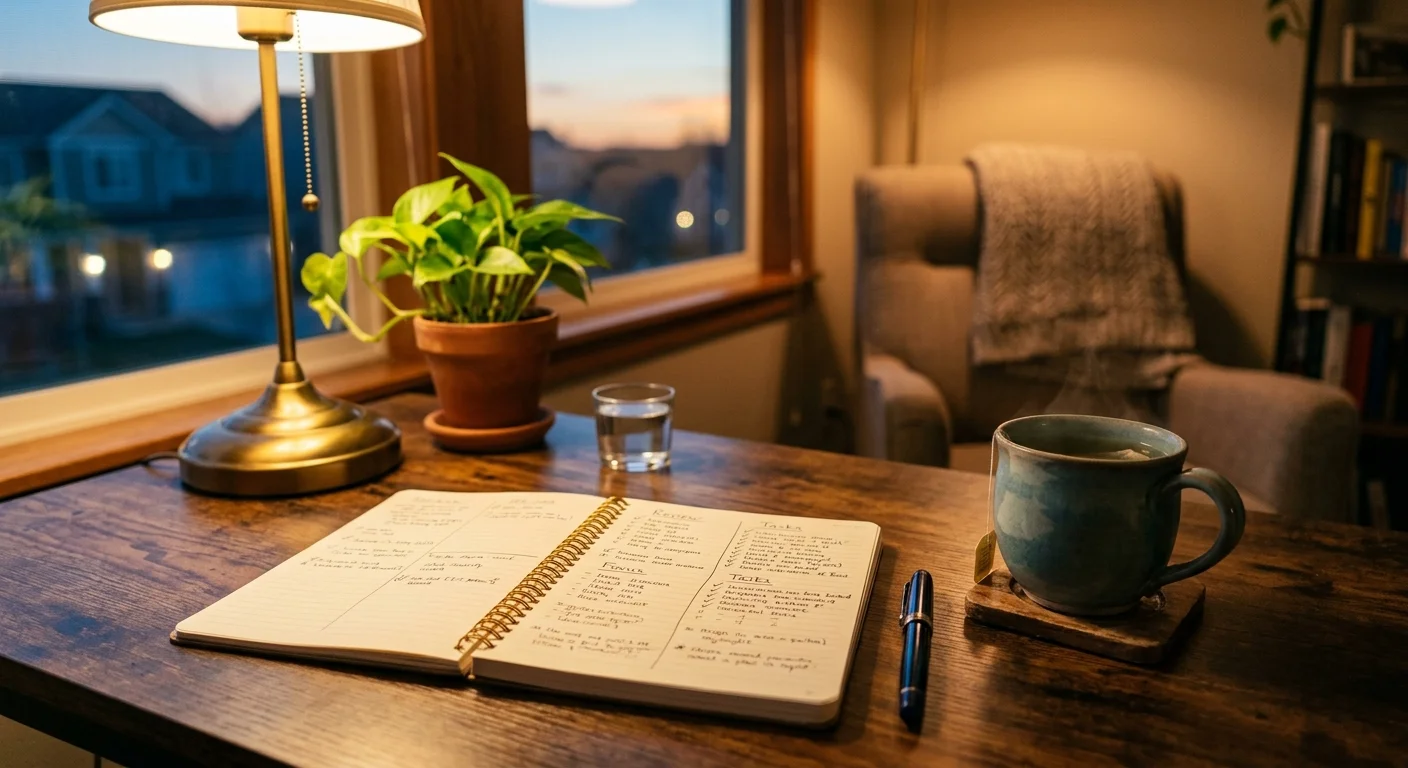
- Empty the tray: everything that has collected over the week - onto the table (10 min).
- Close the loop: what has been done, what has died on its own, what we are transferring (5 min).
- Choose 3 MITs per week - one each Mon/Wed/Fri (5 min).
- Block slots for them in the calendar + buffers (10 min).
- One “NOT to do” for the next week - conscious refusal (2 min).
:::
- Empty the tray: everything that has collected over the week - onto the table (10 min).
- Close the loop: what has been done, what has died on its own, what we are transferring (5 min).
- Choose 3 MITs per week - one each Mon/Wed/Fri (5 min).
- Block slots for them in the calendar + buffers (10 min).
- One “NOT to do” for the next week - conscious refusal (2 min).
This ritual is like synchronizing a clock: without it, the system falls apart in 5–7 days; with it, it lives for months.
12. Adaptations: parents, students, entrepreneurs
- Parents:Plan based on your child's sleep, not on the ideal: one MIT during nap time + 25-minute micro-blocks;
- students:session = marathon of intervals: 3 blocks of 90 minutes with walks in between, not the night before the exam;
- entrepreneurs:“meeting” day and “factory” day separately - a mixed day kills both modes.
Bottom line:Effective time management isn't about rushing through tasks, but rather structuring your day: one main task, protected slots, a tray instead of a head, and a weekly review. Start small—a three-day audit + one MIT tomorrow morning. In two weeks, you'll find that "I can't get anything done" has been replaced by "the most important things are done by lunch." And that's freedom. ⏱️
❓ FAQ
Why don't to-do lists work?
A list without a calendar is a wish list: the brain can't see WHEN to do it, so it puts it off. The "list → calendar slot" connection works: the task gets a time and an address.
How many tasks should you plan for the day?
One major task (MIT) and up to two minor ones. Planning 7–10 tasks is guaranteed to be stressful: time estimates are always underestimated (planning error), so it's better to underplan.
What to do with constant interruptions at work?
Collect them in a "tray": don't react immediately, but rather process them with windows 2-3 times a day. Plus, designate them as "focus hours" on your calendar—colleagues respect a busy slot more than an open door.
Will time management help with procrastination?
Partially: procrastination is an emotion, not laziness. Small initial steps (the 2-minute rule) and a zero-sum start (like "I'll work for 10 minutes") work – the brain gets hooked and continues.
Which methodology is better: GTD, Pomodoro, or the Eisenhower Matrix?
There's no "best" system—there are layers: collection (GTD), priorities (Eisenhower), and execution (Pomodoro/blocks). Take one layer at a time, not the entire methodology.
How can those with children and a second job manage to keep up?
Through energy, not hours: 90 minutes of deep work at the peak of your chronotype yields more than four hours of "leftover" work in the evening. Plus, stick to the strict rule of one priority per day.
📚 Read also

Biohacking 2026: Body Upgrade Based on Science – What Works and What's Just Marketing
Biohacking isn't about "hacking your body" with pills, as advertised, but rather an engineering approach to the body: measure, change one variable, and look at the data. We'll explore which tools of 2026 will truly provide energy and clarity, and which are just pretty placebos.

Digital Detox: How to Regain Your Focus and Energy When the Screen Is Closer Than Family
A digital detox isn't about giving up technology, but about reclaiming your power to choose where to look and when to respond. A practical guide with an attention audit, three detox levels, and a 7-day reboot protocol for those who live in notifications.

💬 Comments (0)
No comments yet. Be the first!
Leave a comment
Comments are pre-moderated.