
AI Leads Us to the Stars: How Artificial Intelligence Will Explore Space in 2026
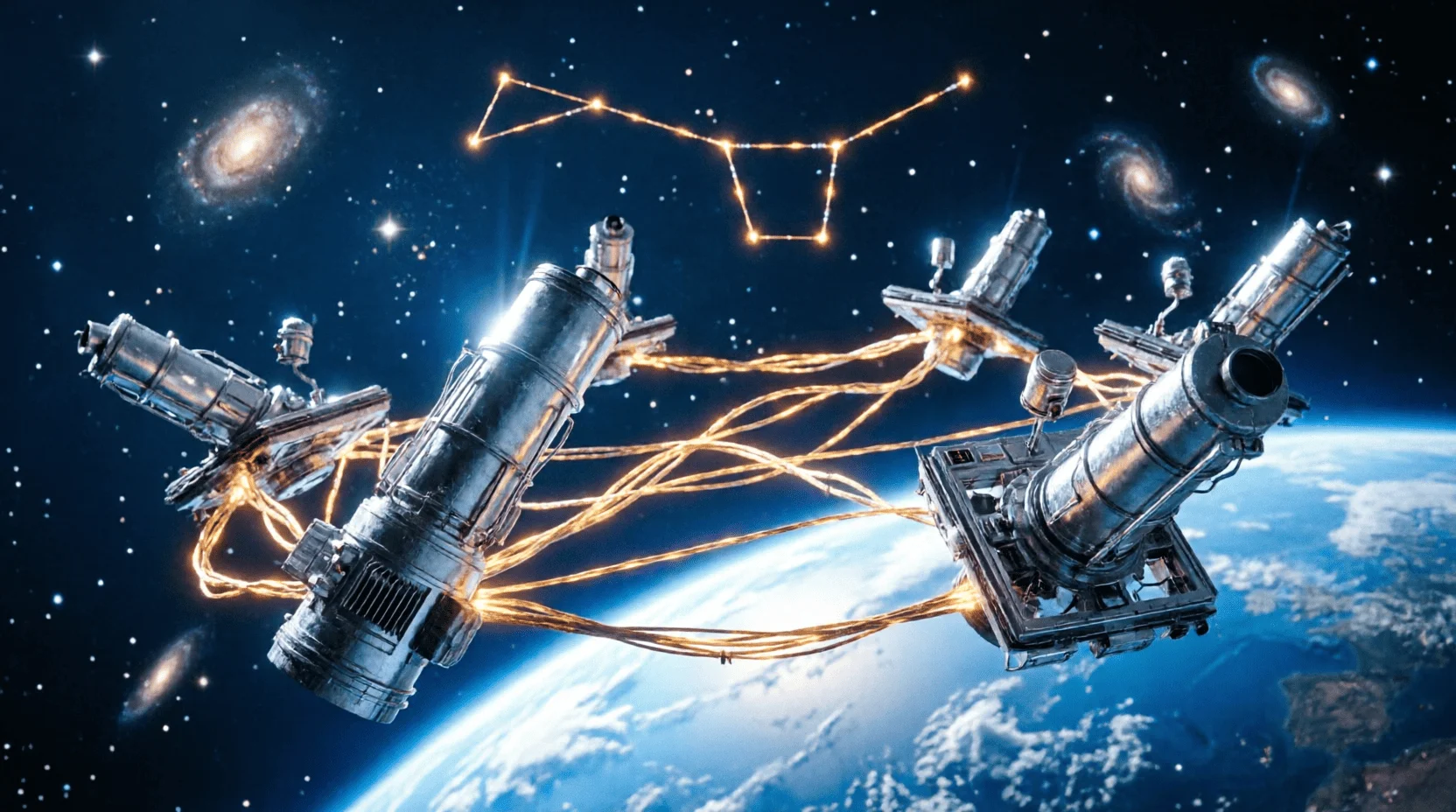
When a neural network first independently found an exoplanet missed by classical algorithms, astronomers began to talk about a new era: space is being explored not only by humans, but also by their digital allies. In 2026, artificial intelligence will guide Mars rovers, predict collisions with space debris, listen to the radio silence of the universe, and design missions that would take decades for humans. The teamLemag.kzI've compiled all the key areas of AI space exploration in one article—with figures, missions, and a look at Kazakhstan.
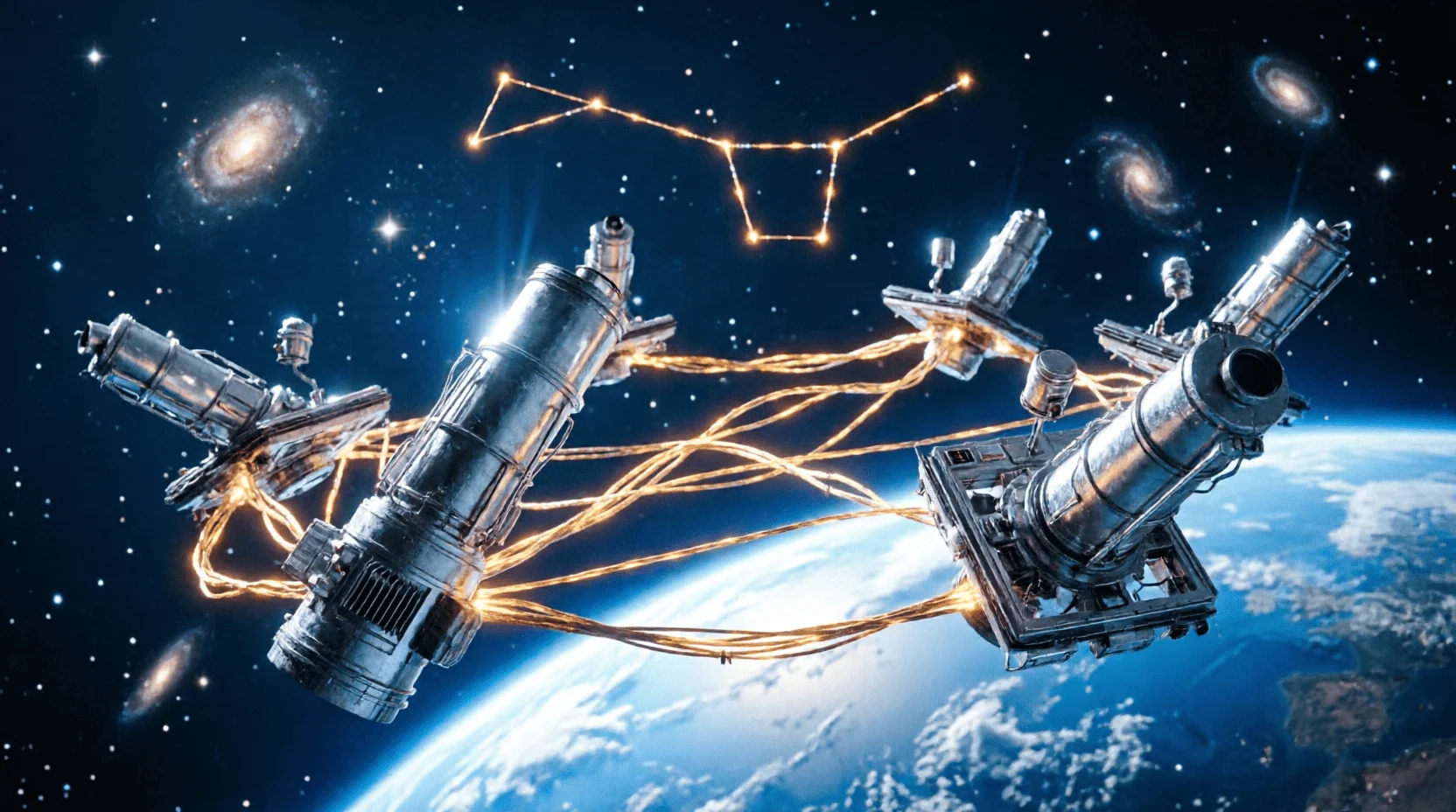
1. A New Era: Why Space Needs AI Now
The amount of data humanity receives about space doubles every two years. The TESS telescope alone produces tens of gigabytes of photometry per day, and the upcoming Vera Rubin observatory will add20 terabytes every nightA human being is physically incapable of viewing this stream, and classical algorithms produce too many false positives.
- Data:modern observatories generate petabytes of signals, in which the rarest events are hidden;
- Communication delays:The team travels up to 22 minutes one way to Mars - the device must decide for itself;
- Mission costs:Every mistake in orbit costs hundreds of millions of dollars, and AI reduces the cost of risk.
Space has become the first industry where AI is not an assistant, but an infrastructure: without neural networks, there is simply no one to read modern data.
2. Exoplanet Hunters: Neural Networks Read Starlight
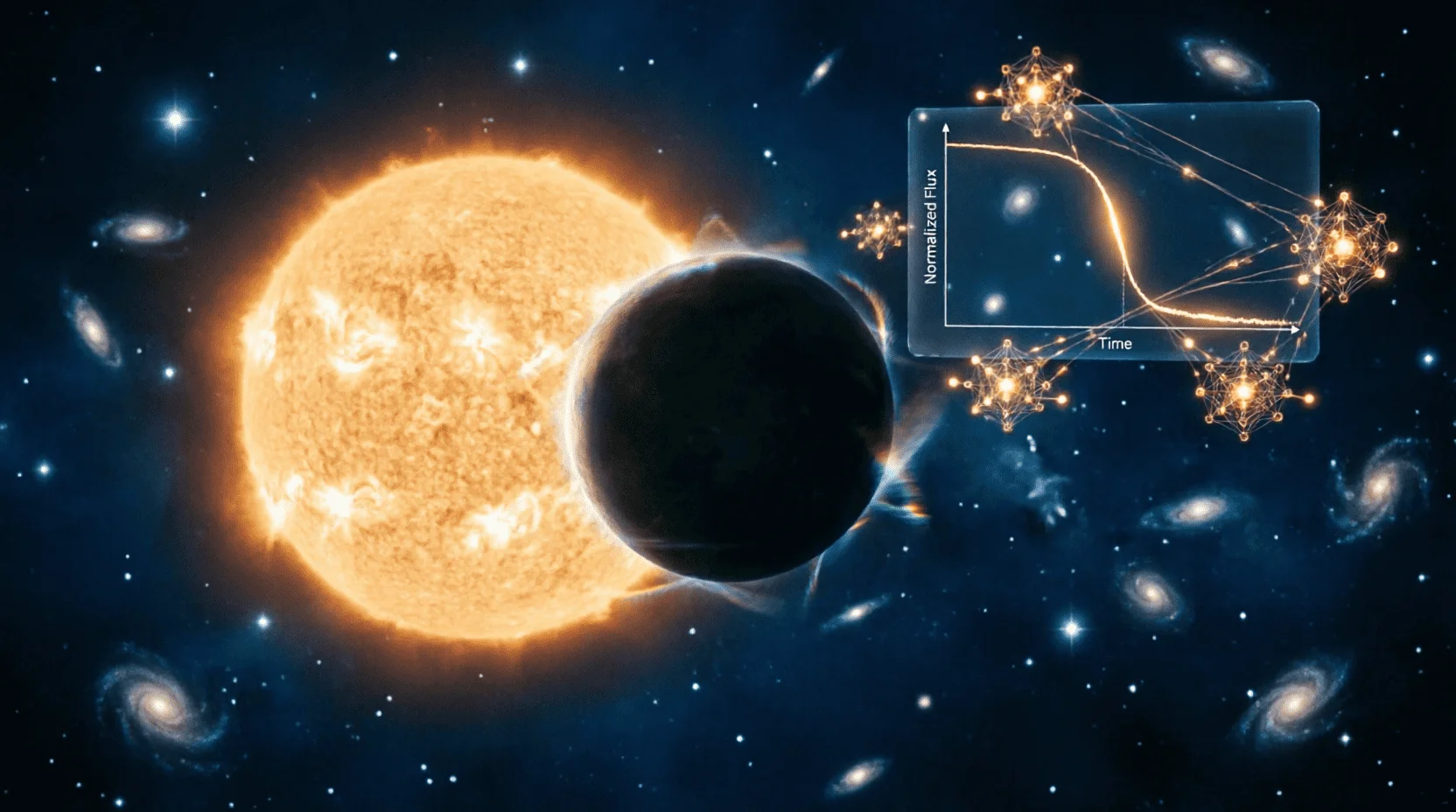
The transit method is simple in concept: a planet passing across a star's disk slightly dims its light. However, the dip in brightness from an Earth-like planet is a fraction of a percent, masked by noise, spots on the star, and the vibrations of the telescope itself.
What AI does:Convolutional neural networks are trained on millions of light curves and distinguish genuine transits from artifacts with over 96% accuracy. This is how dozens of habitable zone candidates, labeled as "noise" by traditional pipelines, were confirmed.
- Speed: the neural network processes the star curve in milliseconds;
- Sensitivity: detects dips of 0.01% and weaker;
- Scale: One cluster analyzes data from hundreds of thousands of stars simultaneously.

Each candidate identified by the AI is a target for spectroscopy: the next step is to "x-ray" the planet's atmosphere for the presence of water, oxygen, and methane. Neural networks have shortened the time from raw data to the target list from months to days.
3. Autonomous Mars Rovers: AI on the Surface of the Red Planet
The Perseverance rover operates in a mode that Spirit could only dream of: its autonomous navigation system creates a 3D map of the terrain and navigates between rocks, while the SuperCam machine vision instrument selects rocks for laser analysis.
- Auto navigation:up to 200 meters per sol without commands from Earth - previously it was 100;
- AI Geologist:The spectrometer classifies the rock on site and decides whether it is worth drilling;
- Ingenuity helicopter:Its flights were entirely controlled by autonomous algorithms—communication with Earth was used only for post-analysis.
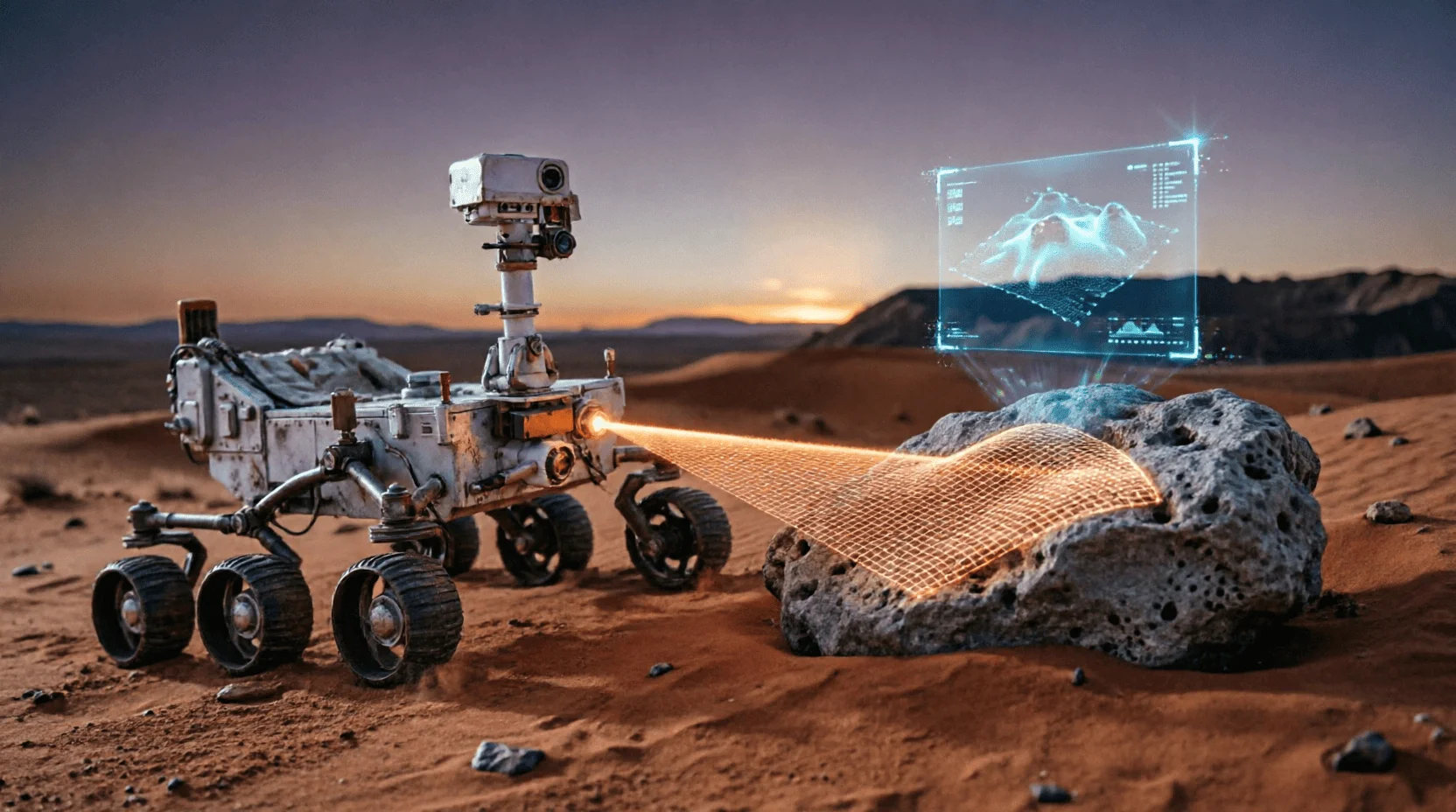
Result for science:The samples the rover collected "of its own free will" are already awaiting a return mission—Mars Sample Return is designed so that the lander will search for containers on the ground using machine vision, without beacons.
4. Orbital Shield: AI vs. Space Debris
There are more than 36,000 trackable objects and hundreds of thousands of untraceable fragments in low-Earth orbit. Each approach requires a decision within hours: a maneuver costs fuel and disrupts the satellite's operations, while a miscalculation costs the spacecraft.
- 72 hour forecast:Neural networks refine trajectories using radar data, reducing false alarms by 40%;
- Auto-evasion:modern communication satellites plan maneuvers without operator intervention;
- Active cleaning:Stage capture missions use AI docking with a non-cooperative object - a rotating piece of debris.
A single cascading incident (Kessler syndrome) could render orbits unusable for generations. AI dispatching is the only realistic way to maintain an orbital economy: communications, navigation, and Earth monitoring.
5. Deep Space Communications: Predictive Antennas and DTN
The farther the device, the weaker the signal and the more valuable each bit. AI optimizes coding and predicts interference, and the DTN (delay/disruption tolerant network) architecture automatically routes data through a chain of repeaters, "waiting out" connection interruptions.
- Adaptive modulation for weather forecast on the signal-to-Earth route;
- Traffic prioritization: science vs. telemetry vs. photo;
- LCRD Laser Link: AI maintains a beam between moving terminals.
6. The Search for Life: Biosignatures and Next-Generation SETI
AI doesn't believe in miracles—it calculates probabilities. In the spectra of exoplanet atmospheres, neural networks search for gas pairs that cannot coexist for long without life (oxygen and methane), and in SETI radio data, they identify anomalies that are unlike either pulsars or terrestrial interference.
Numbers:Classic SETI scanned thousands of channels; modern pipelines scan millions and reduce humanity's "stop list" to dozens of signals worthy of repeated observation.
7. Mission Design: Digital Twins and Orbit Optimization
Previously, a team of ballistics scientists spent months calculating a trajectory to Jupiter. Today, AI can run through millions of gravity assist options in hours, finding solutions that humans wouldn't consider because they weren't aesthetically pleasing.
- Digital twins:a virtual copy of the device runs through thousands of emergency situations before launch;
- Generative design:antennas and brackets “grown” by a neural network are 30–45% lighter than human ones;
- Resource planning:The AI balances energy, fuel, and science for the duration of the mission.
8. Autonomous vehicles: from reusable stages to nanosatellites
Landing a reusable stage is controlled in real time, with no human intervention: algorithms land the stage on the barge with an accuracy of meters, regardless of wind and sea conditions. In low-space environments, AI-powered nanosatellites automatically select the frames to capture and compress the data onboard, saving scarce communication bandwidth.
9. Moon 2026: AI in the Artemis Program
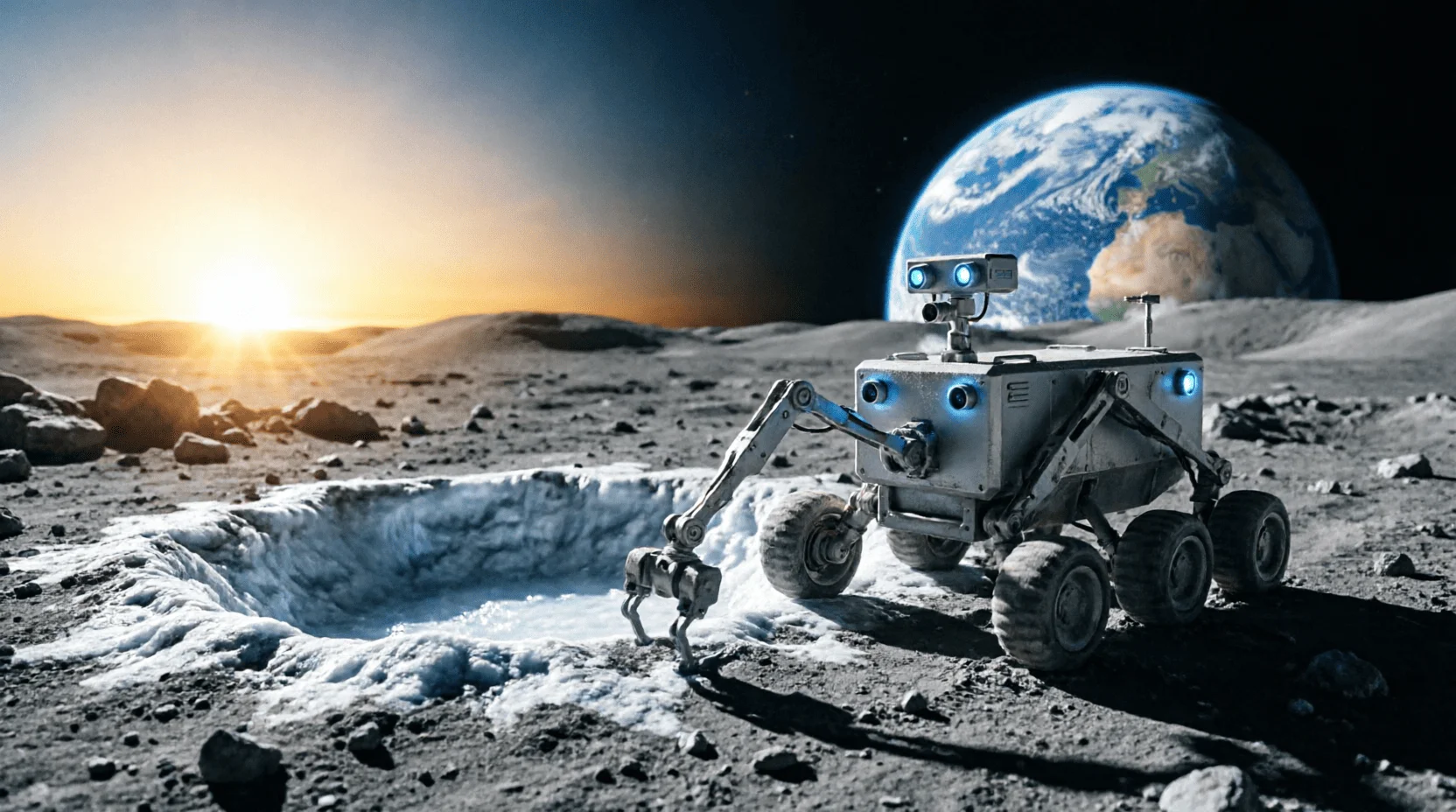
The Gateway lunar station and Artemis landers are being built as autonomous robotic infrastructure: VIPER rovers search for ice at the south pole, and an AI scheduler distributes power between the crew and instruments during the two-week lunar night at -170°C.
- Rovers map ice and select drilling points without an operator;
- AI energy dispatcher survives a moonlit night by sacrificing non-essentials;
- LunaNet connection - "space Wi-Fi" with autonomous routing.
10. The Ethics of Autonomy: Who's Responsible for Decisions 400 Million Kilometers from Earth?
The more autonomous the device, the more pressing the issue of responsibility. In 2026, the industry will converge on the principle of "autonomy with guardrails": AI makes proposals, humans approve—except in situations where communication latency physically prevents waiting.
- Non-standard evasive maneuvers - autonomously (no time to Earth);
- Scientific measurements - autonomously according to the approved plan;
- Irreversible actions (drop, landing in a new zone) - only with a person.
- Look at the level of autonomy: “he decided it himself” or “he proposed it himself”?
- Check who confirms the discoveries: the neural network selects, a person confirms.
- Evaluate the data: the mission is important for the volume and quality of observations, not for the big AI brand name.
- Keep an eye on Kazakhstan: local AI satellite imagery services are the next entry point into the industry.
:::
- Look at the level of autonomy: “he decided it himself” or “he proposed it himself”?
- Check who confirms the discoveries: the neural network selects, a person confirms.
- Evaluate the data: the mission is important for the volume and quality of observations, not for the big AI brand name.
- Keep an eye on Kazakhstan: local AI satellite imagery services are the next entry point into the industry.
11. Kazakhstan in AI Space: From Baikonur to Satellite Images
Kazakhstan is a space power by right of geography and infrastructure: Baikonur, its own QazSat communications satellites, and the KazEOSat Earth remote sensing constellation. A growth area is data processing: ML services based on space imagery are already being used to monitor agriculture, glaciers, and emergency situations.
- KazEOSat-1/2:images with a resolution of up to 1 m are raw material for agricultural and eco-analytics;
- ML monitoring:neural networks detect changes in fields, snow cover, and floods;
- Baikonur:Digital twins and predictive analytics of launch complexes are a niche for local teams.
| Направление | Пример в мире | Потенциал Казахстана |
|---|---|---|
| Поиск экзопланет | TESS + CNN | обработка открытых данных, образование |
| Автономные роверы | Perseverance | ML для роверов будущих лунных миссий |
| Космический мусор | ИИ-диспетчеризация | аналитика для спутников QazSat |
| Космоснимки | Sentinel + ML | агро/эко-мониторинг, ЧС |
| Связь | DTN, лазерные линии | наземные станции приёма |
12. What's next: Interstellar probes with AI on board
The main project on the horizon is probes to the outskirts of the solar system and beyond. Communication with them will take years, so these devices are designed as "scientists in a box": the AI itself selects observation targets, calibrates the instruments, and decides which data is worth the multi-year journey home. This is the highest form of trust in a machine—and the highest form of responsibility for the developer.
Result:Artificial intelligence doesn't "replace" space exploration—it makes it possible on a scale that humans alone can't handle. Exoplanets, debris, Mars rovers, lunar nights, and interstellar routes: wherever there's more data than people, a neural network is at work. This means the generation currently studying data science in Kazakhstan has a direct ticket to the stars—they can start processing open-source space images today.
❓ FAQ
How does AI find exoplanets better than humans?
Neural networks continuously analyze star light curves and detect brightness dips as small as 0.01% that humans or classical algorithms miss. This is how terrestrial planets are located in habitable zones.
Is it true that the Mars rover makes decisions on its own?
Yes, partially: the autonomous navigation system creates a 3D map of the area and chooses a safe route without commands from Earth, and the AI spectrometer itself decides which rock to drill.
Why is AI needed against space debris?
There are tens of thousands of objects in orbit, and their trajectories are changing. The AI predicts approaching orbits 72 hours in advance and plans evasive maneuvers for the satellites—faster and more accurate than traditional ballistics.
Will AI help us find extraterrestrial life?
AI searches for biosignatures in the spectra of exoplanet atmospheres and anomalies in SETI radio data. It neither "believes" nor "doubts"—it selects from millions of signals the 0.001% that merit human verification.
What is Kazakhstan's contribution to AI space?
Kazakhstan is developing the QazSat satellite constellation and Earth remote sensing, and local teams are using machine learning to process space images and monitor Baikonur—the basis for their own AI-powered space services.
Will AI replace astronauts?
No: AI takes over routine tasks, monitoring, and calculations, but strategic decisions and emergency repairs remain with humans. The trend for 2026 is a crew plus an AI copilot, not a crew instead of AI.
📚 Read also

Эволюция искусственного интеллекта от диалоговых ботов к автономным исполнителям
ИИ-агенты знаменуют эволюционный переход от традиционных чат-ботов к автономным цифровым исполнителям, способным самостоятельно планировать действия, управлять интерфейсами компьютеров и выполнять сложные многошаговые задачи в фоновом режиме без постоянного контроля человека. В отличие от простых систем формата «вопрос-ответ», ключевые решения от ведущих техногигантов — включая OpenAI (Operator/Dots), Anthropic (Claude Computer Use), xAI (Grok), Microsoft, Google и Salesforce — нацелены на достижение конкретного результата: от написания кода и работы в CRM до управления личными сервисами и приложениями. Развитие этой технологии кардинально меняет подход к автоматизации, смещая фокус с обычной генерации текста на решение реальных прикладных задач и оценку эффективности по конечному результату.

Развитие искусственного интеллекта: мультимодальность Astra и аналитическая мощь Claude Opus 5.5
Сравнительный анализ двух концептуальных векторов развития искусственного интеллекта — визуально-пространственного (Google Astra) и аналитико-агентного (Claude Opus 5.5). Современный ИИ развивает две разные компетенции: Astra становится «глазами и ушами» человека в физическом мире, а Claude Opus 5.5 взяла на себя роль автономного эксперта в цифровой среде и инженерии.

Такси без водителя: Waymo, Cybercab, Yandex и перспективы в Казахстане
Waymo (Google) ездит по США с 2020 года: десятки городов, 4 пассажира, лидар + камеры, уже выезжает на трассы. Цена примерно как у Uber. Tesla Cybercab только стартовал в сентябре 2026 в Остине: 2 места, без руля и педалей, только камеры. Обещают сильно дешевле — до $0,20–0,40 за милю. В Казахстане Yandex уже тестирует роботакси в Алматы. Пилот в трёх городах, коммерческий запуск — 2027. Будущее ближе, чем кажется. Кто быстрее сделает поездки дешевле и безопаснее?
💬 Comments (0)
No comments yet. Be the first!
Leave a comment
Comments are pre-moderated.