
Augmented and Mixed Reality (AR/MR) 2026: From Apple Vision Pro to Industrial Applications — Technologies, Applications, Kazakhstan Market, and the Future of Spatial Computing
faq:
- question: "What is spatial computing?"
answer: "Spatial computing is a technology that combines physical and digital worlds, allowing interaction with digital content in three-dimensional space using AR/MR devices."
- question: "How much does Apple Vision Pro cost in Kazakhstan?"
answer: "Official price is $3,499 (about 1.6M ₸), but with shipping and taxes in KZ the price reaches 1.8–2.2M ₸. Meta Quest 3 is cheaper — from 600K ₸."
- question: "What's the difference between VR, AR, and MR?"
answer: "VR (Virtual Reality) is a fully digital world; AR (Augmented Reality) overlays digital objects on the real world; MR (Mixed Reality) allows digital objects to interact with the real world."
- question: "Where is AR/MR used in Kazakhstan?"
answer: "Industry (remote assistance, training), medicine (surgery, diagnostics), education (3D visualization), retail (virtual try-ons), construction (BIM modeling)."
- question: "What are the requirements for AR/MR devices?"
answer: "Powerful processor (M2/M3 for Vision Pro), minimum 8 GB RAM, 256 GB+ SSD, high-speed internet (Wi-Fi 6), minimum 2x2 meter space."
- question: "When will AR/MR become mainstream?"
answer: "Forecast: 2027–2028 for premium segment, 2030+ for mass market when prices drop to $1000–1500 and killer apps appear."
- question: "How can business implement AR/MR?"
answer: "Start with pilot projects (employee training, remote support), choose platform (Apple visionOS, Meta Horizon), prepare content, train staff, scale upon success."
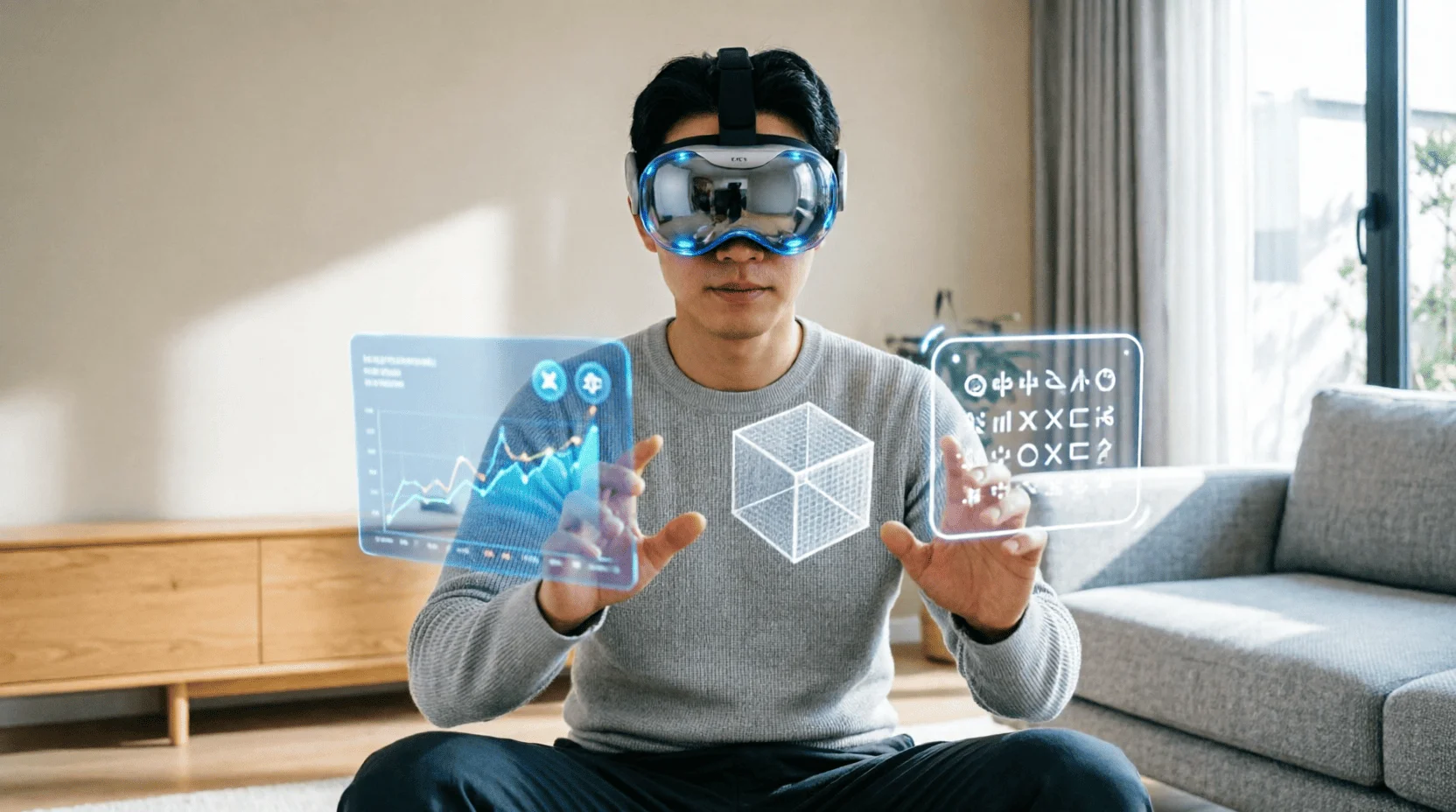
Spatial computing is no longer science fiction. Following the launch of Apple Vision Pro in 2024 and the release of Meta Quest 3, the AR/MR industry is experiencing explosive growth: the market is growing 40–50% annually, devices are becoming more affordable, and applications are becoming more useful. The Lemag.kz team breaks down augmented and mixed reality technologies of 2026: from consumer devices to industrial applications in Kazakhstan, with real prices, implementation cases, and development forecasts.
1. What is AR/MR: Evolution of Spatial Computing
? Definitions:
- VR (Virtual Reality): Fully immersive digital environment isolating from the real world (Oculus Rift, HTC Vive).
- AR (Augmented Reality): Digital objects overlay on the real world via smartphone, tablet, or glasses (Pokémon Go, IKEA Place).
- MR (Mixed Reality): Digital objects don't just overlay but interact with the real world (Apple Vision Pro, Microsoft HoloLens).
- XR (Extended Reality): Umbrella term for all immersive technologies.
? Evolution:
- 2010s: AR on smartphones, first VR headsets;
- 2020–2023: Standalone VR (Quest), industrial AR (HoloLens);
- 2024–2026: Spatial computing (Vision Pro), mass MR (Quest 3);
- 2027–2030: Lightweight AR glasses, AI integration, mass adoption.
? Why now:
- Technologies: Display miniaturization, powerful processors, precise sensors;
- Content: Ready platforms (visionOS, Horizon OS), development tools;
- Demand: Remote work, education digitalization, Industry 4.0.
2. AR/MR Devices 2026: Comparison and Prices
? Apple Vision Pro
| Parameter | Value |
|---|---|
| Price | $3,499 (1.6–2.2M ₸ in KZ) |
| Processor | M2 + R1 (specialized for sensors) |
| Displays | 2x micro-OLED 4K (23M pixels) |
| Sensors | 12 cameras, 5 sensors, LiDAR |
| OS | visionOS (Apple ecosystem integration) |
| Weight | 600–650g |
| Battery life | 2–3 hours (external battery) |
Pros:
- Best image quality
- Seamless Apple device integration
- Premium materials
- Eye tracking + hand tracking (no controllers)
Cons:
- Very high price
- Limited battery life
- Heavy for extended use
For whom: Professionals, Apple enthusiasts, developers.
? Meta Quest 3
| Parameter | Value |
|---|---|
| Price | $499–649 (230–300K ₸) |
| Processor | Snapdragon XR2 Gen 2 |
| Displays | 2x LCD 2064×2208 per eye |
| Sensors | 4 cameras, IR sensors |
| OS | Meta Horizon OS |
| Weight | 515g |
| Battery life | 2.5–3 hours |
Pros:
- Excellent price-performance ratio
- Huge content library
- Wireless standalone (no PC needed)
- PC VR support via cable/Wi-Fi
Cons:
- Lower image quality than Vision Pro
- Requires Meta account (privacy concerns)
- Less premium feel
For whom: Gamers, mass consumers, education.
? Microsoft HoloLens 2
| Parameter | Value |
|---|---|
| Price | $3,500 (rental from $100/month) |
| Processor | Snapdragon 850 |
| Displays | Holographic 2K |
| Sensors | 4 cameras, IMU, LiDAR |
| OS | Windows Holographic |
| Weight | 566g |
| Battery life | 2–3 hours |
Pros:
- Enterprise-focused
- Microsoft ecosystem integration
- Hands-free (hand tracking)
- Industrial reliability
Cons:
- Very expensive
- Limited consumer content
- Aging hardware (released 2019)
For whom: Corporate sector, industry, medicine.
Other Devices:
| Device | Price | Features |
|---|---|---|
| Magic Leap 2 | $3,299 | Enterprise, large FOV |
| XREAL Air 2 | $400–600 | Lightweight AR glasses, affordable |
| PICO 4 | $400–500 | Chinese Quest alternative |
Conclusion: For mass market — Meta Quest 3; for professionals — Apple Vision Pro; for business — HoloLens 2.
【? INSERT IMAGE 3 — Industrial AR application】
3. Industrial Applications of AR/MR
Manufacturing and Industry 4.0
Use Cases:
1. Remote Assistance:
- Factory worker wears AR glasses;
- Expert from another city sees what the worker sees;
- Expert draws arrows and annotations directly in worker's field of view;
- Savings: 70% time on diagnostics, 50% travel costs.
Example in Kazakhstan:
- KazMunayGas testing remote support for pipelines;
- Savings on specialist trips: 200–500K ₸ per case.
2. Step-by-Step Instructions:
- AR shows 3D instructions for assembly/repair;
- Worker sees arrows, part highlighting, animation;
- Errors reduced by 40–60%.
3. Quality Control:
- AR overlays CAD model on real object;
- Deviations highlighted in red;
- Precision up to 0.1mm.
Economics:
- AR implementation at factory: 5–20M ₸;
- ROI: 12–18 months;
- Savings: 30–50% training time, 20–40% errors.
? Construction and BIM
Applications:
- Project Visualization: AR shows 3D building model at construction site;
- Compliance Control: Real-time comparison of plan vs. reality;
- Utilities Coordination: Underground pipes and cables visible "through" ground.
Example:
- Almaty construction company using HoloLens 2;
- Installation error reduction: 35%;
- Savings on rework: 10–15M ₸ per project.
4. AR/MR in Medicine
? Surgery
Applications:
- Navigation: 3D organ model overlaid on patient during surgery;
- Training: Young surgeons see experienced surgeons' actions in AR;
- Telemedicine: Remote consultation during complex surgery.
Case:
- National Scientific Center for Surgery (Almaty) testing AR;
- Surgery precision increased by 25%;
- Surgery time reduced by 15–20%.
? Medical Staff Training
- 3D anatomy: students "dissect" virtual organs;
- Procedure simulation: skill practice without risk;
- Accessibility: training anytime, no cadavers needed.
Economics:
- AR system cost: 2–5M ₸;
- Savings on simulators: 500K–1M per year;
- ROI: 2–3 years.
5. Education and Training
? Schools and Universities
Applications:
1. 3D Visualization:
- Students see solar system, molecules, historical events in 3D;
- Interactivity: can "touch" planets, dissect cells;
- Material comprehension: +40% vs textbooks.
2. Virtual Excursions:
- Visit museums, historical sites, other countries;
- No travel costs;
- Accessible for regional schools.
3. Vocational Training:
- Welders practice in VR without material consumption;
- Mechanics disassemble virtual engines;
- Savings: 60–80% on consumables.
? Research:
- Microsoft: AR training 30% faster;
- PwC: VR training 4x more effective than lectures.
? Corporate Training
Cases:
- Kaspi: VR training for service center employees;
- KazakhTelecom: AR instructions for tech support;
- Mining Industry: Safety training exercises.
Economics:
- VR training implementation: 3–10M ₸;
- Savings on instructors: 40–60%;
- Training time reduction: 50%.
【? INSERT IMAGE 4 — Medical AR application】
6. Retail and Marketing
? Virtual Try-Ons
Applications:
- Clothing: Customer sees how item looks without physical fitting;
- Footwear: AR shows shoes on feet via smartphone camera;
- Accessories: Glasses, watches, jewelry.
Examples:
- Lacoste: AR try-on in app;
- Nike: Virtual try-on for sneakers;
- Kaspi.kz: Testing AR for furniture.
Effect:
- Returns reduced by 25–40%;
- Purchase conversion: +20–30%;
- Time on site: +40%.
? Product Visualization
IKEA Place:
- Buyer sees how furniture fits in interior;
- Exact 1:1 scale;
- Can "place" multiple items.
Economics:
- AR app development: 5–15M ₸;
- ROI: 6–12 months;
- Sales increase: 15–25%.
7. Entertainment and Gaming
? Gaming
Meta Quest 3:
- Library: 500+ games and apps;
- Popular: Beat Saber, Asgard's Wrath 2, Resident Evil 4 VR;
- Social: Games with friends in virtual space.
Apple Vision Pro:
- Immersive Video: 3D movies, concerts;
- Games: Fewer than Meta, but growing;
- Integration: Apple Arcade games.
Prices:
- Games: $10–60;
- Subscription: Apple Arcade $5/month.
? Cinema and Content
Apple Vision Pro:
- Apple TV+: Immersive films;
- National Geographic: 3D documentaries;
- NBA: Watch games with presence effect.
Meta Quest:
- Meta Horizon Worlds: Social VR platform;
- YouTube VR: 360° video;
- Bigscreen: Watch movies in virtual cinema.
8. AR/MR in Kazakhstan: Market and Prospects
? Current State (2026)
Consumer Segment:
- Devices: Meta Quest 3 (main), occasional Vision Pro;
- Sales: 500–1000 devices per year;
- Price: Quest 3 from 230K ₸, Vision Pro 1.8–2.2M ₸;
- Audience: Gamers, IT enthusiasts, creative class.
Corporate Segment:
- Implementations: 10–20 companies (oil & gas, construction, medicine);
- Devices: HoloLens 2, PICO 4, occasional Vision Pro;
- Budgets: 5–50M ₸ per project;
- ROI: 12–24 months.
Government Sector:
- Education: Pilots at Nazarbayev University, KBTU;
- Medicine: Scientific centers in Almaty, Astana;
- Industry: KazMunayGas, mining companies.
Prospects
2026–2027:
- Market growth 40–50% annually;
- Emergence of local AR/MR startups;
- Implementation in major retailers (Magnum, Small).
2028–2030:
- Price drop to 300–500K ₸ for good MR devices;
- Mass implementation in education (schools, universities);
- Emergence of Kazakhstani AR content.
2030+:
- Lightweight AR glasses (like regular glasses);
- AI integration (voice assistants in AR);
- Mass market (10–20% of population).
? Opportunities for Business
1. Content Development:
- AR apps for retail;
- VR training for corporations;
- Games and entertainment.
2. Integration and Consulting:
- AR/MR implementation at enterprises;
- Employee training;
- Technical support.
3. Device Rental:
- Event agencies (VR entertainment);
- Education (schools, universities);
- Corporate events, team building.
Startup Investment:
- Small studio: 2–5M ;
- Full company: 10–30M ₸.
【? INSERT IMAGE 5 — AR in Education】
9. AR/MR Development: Tools and Platforms
? Development Tools
1. Apple visionOS:
- Language: Swift, SwiftUI;
- Environment: Xcode;
- Frameworks: RealityKit, ARKit;
- Requirements: Mac, Apple Developer ($99/year).
2. Meta Horizon OS:
- Language: C#, C++;
- Engine: Unity, Unreal Engine;
- Platform: Meta Quest Developer;
- Cost: Free.
3. Microsoft Mixed Reality:
- Platform: Azure Mixed Reality Services;
- Tools: Unity, Visual Studio;
- Cloud: Azure Spatial Anchors.
4. Cross-platform:
- Unity + XR Interaction Toolkit: One codebase for all devices;
- Unreal Engine: High-quality graphics;
- WebXR: AR/MR in browser (no app installation).
? Development Cost
| Project | Complexity | Duration | Cost |
|---|---|---|---|
| Simple AR app | Low | 1–2 months | 2–5M ₸ |
| VR training | Medium | 3–6 months | 5–15M ₸ |
| Enterprise MR solution | High | 6–12 months | 15–50M ₸ |
| Game/entertainment | Medium | 6–12 months | 10–30M |
? Development Team
- Unity/Unreal developer: 400–800K ₸/month;
- 3D artist: 300–600K ₸/month;
- UX/UI designer: 300–500K ₸/month;
- Project manager: 500–900K ₸/month.
10. AR/MR Challenges and Limitations
⚠️ Technical
1. Weight and Ergonomics:
- Devices are heavy (500–650g);
- Fatigue after 1–2 hours of use;
- Pressure on face and neck.
2. Battery Life:
- 2–3 hours autonomous operation;
- Need for recharging;
- External batteries inconvenient.
3. Field of View (FOV):
- Limited FOV (40–50° on Vision Pro, 100° on HoloLens);
- Digital objects don't fill entire vision;
- "Looking through keyhole" effect.
4. Resolution:
- Although Vision Pro has 4K per eye, pixelation still noticeable;
- Text rendering needs improvement.
? Economic
1. High Price:
- Vision Pro: $3,499 — inaccessible for masses;
- Quest 3: $499 — more accessible, but still expensive;
- Enterprise devices: $3,000+.
2. Content:
- Few "killer apps" (apps that make people buy device);
- Most apps are demos or simple games;
- Development is expensive.
3. Ecosystem:
- Fragmentation: different OS, different stores;
- Lock-in: Purchased apps don't work on other devices.
? Privacy and Security
1. Data Collection:
- Cameras and sensors constantly scan surroundings;
- Data about home, office, habits;
- Questions: where is data stored, who has access.
2. Security:
- Risk of hacking AR devices;
- Corporate data leaks;
- Deepfake in AR (fraud).
3. Social Aspects:
- People in AR glasses don't see reality;
- Risk of injuries, traffic accidents;
- Social isolation.
11. Future of AR/MR: 2027–2035
? Forecasts
2027–2028:
- Apple Vision Pro 2: Lighter, cheaper ($2,499), longer battery life;
- Meta Quest 4: Improved resolution, AI integration;
- Google AR glasses: Return to market;
- Samsung/Qualcomm: New AR/MR chips.
2029–2030:
- Lightweight AR glasses: Regular glasses form factor (Ray-Ban Meta);
- Prices: $1,000–1,500 for good MR devices;
- 5G/6G: Cloud rendering, reduced device requirements;
- AI integration: Voice assistants, generative content.
2031–2035:
- AR contact lenses: First prototypes (Mojo Vision, Innovega);
- Neurointerfaces: Mind control (Neuralink + AR);
- Mass adoption: 30–50% of population uses AR daily;
- Spatial Web: Internet not on screen, but around us.
? Future Technologies
1. Displays:
- MicroLED: Brighter, more energy efficient;
- Holographic: True 3D holograms;
- Retinal projection: Direct projection onto retina.
2. Sensors:
- LiDAR 2.0: Millimeter precision;
- Neuromorphic sensors: Processing like human eye;
- Haptic feedback: Tactile feedback (feeling virtual objects).
3. AI:
- Generative AI: Creating 3D content from text description;
- Computer Vision: Understanding context (what you're doing);
- Predictive AR: Predicting user actions.
12. How to Choose AR/MR Device in 2026
? Selection Checklist
1. Define Purpose:
- Gaming and entertainment: Meta Quest 3;
- Professional work: Apple Vision Pro;
- Business/Enterprise: Microsoft HoloLens 2;
- Budget option: PICO 4, XREAL Air 2.
2. Budget:
- Up to 300K : Meta Quest 3 (used or sale);
- 300–600K ₸: Meta Quest 3 new, PICO 4;
- 600K–1M ₸: Vision Pro used;
- 1.5M+ ₸: Apple Vision Pro new, HoloLens 2.
3. Ecosystem:
- Apple user: Vision Pro (seamless integration);
- Android/PC user: Quest 3, PICO 4;
- Windows/Enterprise: HoloLens 2.
4. Content:
- Gaming: Quest 3 (huge library);
- Productivity: Vision Pro (Mac integration);
- Business apps: HoloLens 2.
? Where to Buy in Kazakhstan
Official:
- Apple: iSpace, re:Store (Vision Pro by order);
- Meta: No official representation;
- Microsoft: Partners (HoloLens by order).
Gray Import:
- Kaspi.kz (Quest 3, PICO 4);
- Instagram shops;
- OLX (used devices).
Prices (approximate):
- Meta Quest 3 128GB: 230–280K ₸;
- Meta Quest 3 512GB: 280–350K ₸;
- PICO 4: 200–250K ₸;
- Apple Vision Pro: 1.8–2.2M ₸;
- HoloLens 2: 1.5–2M ₸ (rental from 100K ₸/month).
13. Connection to Other Lemag.kz Articles
? Semiconductors — M2, R1, Snapdragon XR2 chips: hardware foundation of AR/MR.
? Neural Networks for Content — Generating 3D models and content for AR/MR.
? Cybersecurity — Data protection and privacy in AR/MR.
Game Design — Creating immersive games for VR/MR.
Conclusion: AR/MR technologies in 2026 have moved from "interesting toy" to "practical tool" stage: Apple Vision Pro set the quality bar, Meta Quest 3 made MR accessible, and Kazakhstan industry is beginning to implement AR for training and remote support. Start with Meta Quest 3 to familiarize yourself with the technology, explore visionOS for professional use, consider AR for business if you're an entrepreneur — and in 2–3 years you'll be ready for the mass transition to spatial computing. ✨
❓ FAQ
Что такое пространственные вычисления (spatial computing)?
Spatial computing - технология, объединяющая физический и цифровой миры, позволяющая взаимодействовать с цифровым контентом в трехмерном пространстве с помощью AR/MR устройств.
Сколько стоит Apple Vision Pro в Казахстане?
Официальная цена $3,499 (около 1,6 млн ₸), но с доставкой и налогами в KZ цена достигает 1,8–2,2 млн ₸. Meta Quest 3 дешевле - от 600 тыс. ₸.
В чем разница между VR, AR и MR?
VR (виртуальная реальность) - полностью цифровой мир; AR (дополненная) - цифровые объекты накладываются на реальный мир; MR (смешанная) - цифровые объекты взаимодействуют с реальным миром.
Где применяется AR/MR в Казахстане?
Промышленность (удаленная экспертиза, обучение), медицина (хирургия, диагностика), образование (3D-визуализация), ритейл (виртуальные примерочные), строительство (BIM-моделирование).
Какие требования для AR/MR устройств?
Мощный процессор (M2/M3 для Vision Pro), минимум 8 GB RAM, SSD 256 GB+, высокоскоростной интернет (Wi-Fi 6), пространство 2x2 метра минимум.
Когда AR/MR станут массовыми?
Прогноз: 2027-2028 для премиум-сегмента, 2030+ для массового рынка при снижении цен до $1000-1500 и появлении killer apps.
Как бизнесу внедрить AR/MR?
Начать с пилотных проектов (обучение сотрудников, удаленная поддержка), выбрать платформу (Apple visionOS, Meta Horizon), подготовить контент, обучить персонал, масштабировать при успехе.
📚 Read also
Solar panels for a private home in Kazakhstan 2026: payback, installation, net metering, and energy independence - full calculation in tenge: panel types, power, cost, connection, and maintenance
Solar panels for a private home in 2026 aren't about ecology, they're about economics: a payback of 4-6 years, free electricity for 20+ years, and protection from tariff increases. The Lemag.kz team calculated everything in tenge: the cost of a kit for a 100-200 m² home, the payback at current tariffs, net metering (selling surplus to the grid), DIY installation vs. a team, and real savings figures in Kazakhstan.
Electric vehicles in Kazakhstan 2026: A complete guide to buying, charging, and saving – from model selection to installing a home charging station: models, infrastructure, maintenance, and real figures
Electric cars are no longer a novelty in Kazakhstan: sales are growing by 60% annually, charging stations are popping up in every city, and fuel savings reach 200,000 tenge per month. The Lemag.kz team has put together a complete guide: which models are available in Kazakhstan, where to charge, how to install a home charging station, how much you can realistically save, and what pitfalls await electric car owners.

Кибербезопасность 2026: как защищают данные в мире AI-атак - от фишинга и deepfake до Zero Trust и квантовой криптографии: анатомия взлома, экономика индустрии и чек-лист защиты
Ущерб от кибератак в 2025 году превысил 10 трлн долларов - больше, чем ВВП большинства стран. AI-фишинг с deepfake-голосом обходит двухфакторную аутентификацию, ransomware шифрует больницы за минуты, а квантовые компьютеры угрожают взломать RSA-шифрование в ближайшие годы. Команда Lemag.kz разложила кибербезопасность по слоям: анатомия взлома, типы угроз 2026 года, экономика индустрии, Zero Trust для бизнеса и чек-лист личной защиты за 30 дней.
💬 Comments (0)
No comments yet. Be the first!
Leave a comment
Comments are pre-moderated.