
Concrete: The Most Consumed Material on Earth After Water - Why We Don't Notice It, How It 'Thinks,' Why Roman Concrete Is Stronger Than Modern, and What Will Replace It: Chemistry, Grades, CO2, and Self-Healing Recipes of the Future
faq:
- question: "How does cement differ from concrete?"
answer: "Cement is the binding powder (usually Portland cement), one of the ingredients. Concrete is the finished 'stone' made from a mix of cement, water, sand, and crushed stone. Cement relates to concrete as flour relates to bread."
- question: "How long does concrete last?"
answer: "The design life of modern structures is 50–100 years, after which concrete does not crumble but requires repair due to rebar corrosion and freeze-thaw cycles. Roman marine concrete has stood for 2000 years and gets stronger over time."
- question: "Why does concrete crack?"
answer: "Due to shrinkage while drying, thermal expansion, and bending loads: concrete is strong in compression and weak in tension. Hairline cracks are normal; cracks wider than 0.3 mm and rusty streaks are dangerous — a sign of rebar corrosion."
- question: "How harmful is concrete to the environment?"
answer: "Cement production accounts for 7–8% of global CO2 emissions (about 2.5 billion tons per year). But per kilogram, concrete is cleaner than steel and plastic; solutions include low-clinker cements (LC3), CO2 capture, and recycled aggregate."
- question: "Why doesn't Roman concrete degrade over centuries?"
answer: "It contains lime clasts and volcanic ash: when a crack appears, water reacts with the lime and 'seals' it with new minerals. A 2023 MIT study showed this is self-healing, not coincidence."
- question: "Can concrete be recycled?"
answer: "Yes: old concrete is crushed into recycled aggregate for road bases and pads. Fully returning it into new structural concrete is hard — old cement stone is weaker than fresh, so recycling is currently partial."
- question: "What concrete is needed for a private house foundation?"
answer: "In Kazakhstan's climate, class B22.5 (grade M300) with frost resistance of at least F150 and good water impermeability is usually applied; the exact grade should be specified by the project considering soil and loads."
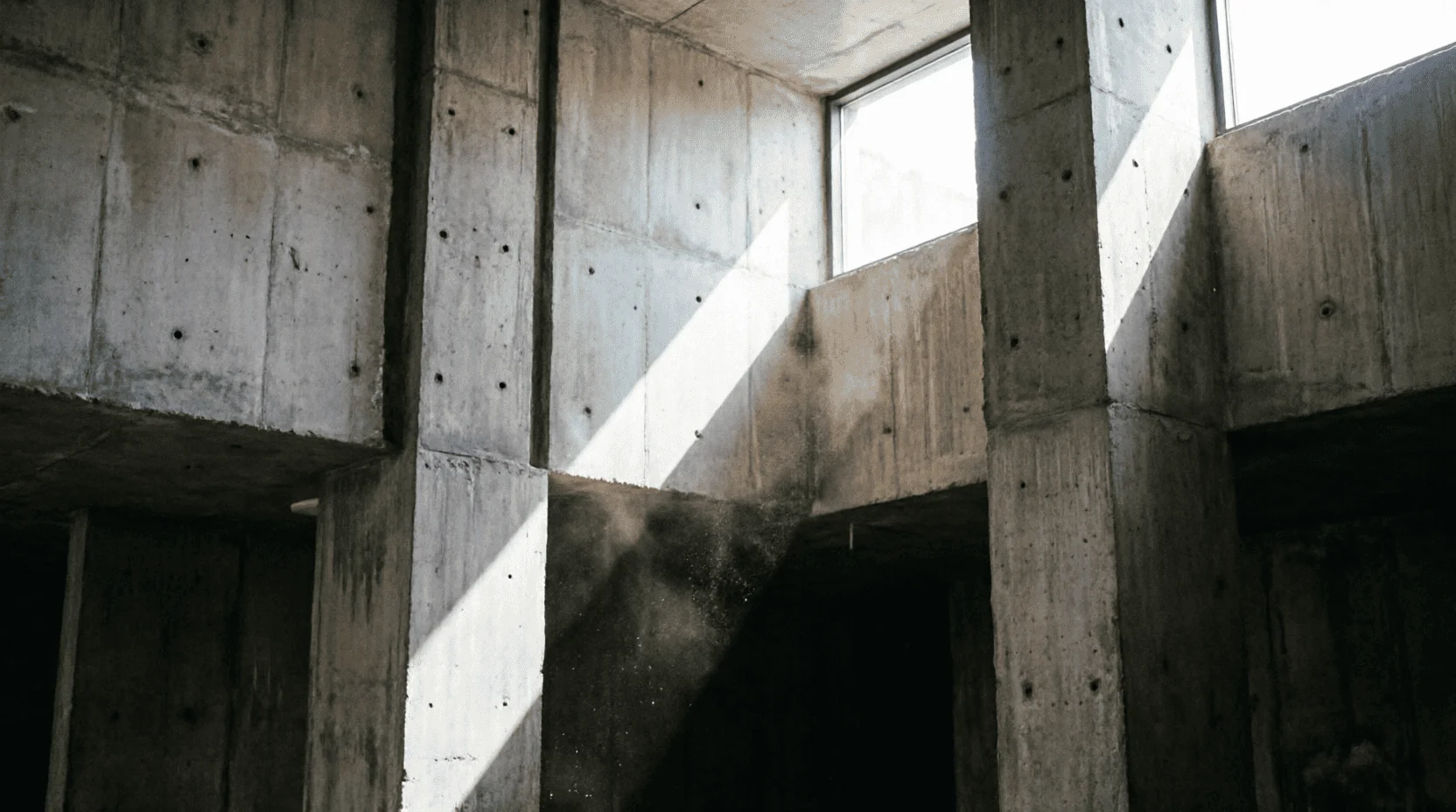
Look around. Even if you are sitting in a 'cozy' apartment with wood and textiles, you are inside a concrete box: foundation, floor slabs, stair flights, elevator shaft walls. Concrete is the second most consumed substance on the planet after water: about 30 billion tons a year, three to four tons per person. Yet we notice it only when it cracks. The new Lemag.kz category 'Things Around Us' begins with the main invisible material of civilization — and it is far more interesting than it seems.
1. The Invisible Material: Why We Don't Notice Concrete
Concrete lost the battle for attention back in the twentieth century: it is deliberately hidden. Plaster, paint, porcelain tile, ventilated facades — the entire finishing industry exists partly so that we do not see the grey stone. The paradox is that the more important a material is, the more invisible it becomes: we notice the wallpaper, but not the slab that holds the wallpaper and us along with it.
Meanwhile, concrete is not a 'grey mass' but a material with character: it slowly gains strength over years, 'breathes' moisture, expands in heat, contracts in frost, creeps under constant load (this is called creep), and can even heal its own microcracks. Look closely, and concrete has a biography.
2. Scale in Numbers: A Material of Which There Is Too Much
? Concrete in numbers:
- ~30 billion tons of concrete consumed by humanity per year;
- ~4.3 billion tons of cement produced annually — more than coal by mass;
- 7–8% of global CO2 emissions come from cement production — about 2.5 billion tons per year; if the cement industry were a country, it would be the third-largest emitter after China and the USA;
- ~3 tons of concrete per inhabitant of the planet per year;
- 43.3 meters — the span of the Roman Pantheon dome, the world's largest unreinforced concrete dome, standing for 1900 years.
⚖️ For comparison: about 1.9 billion tons of steel and about 450 million tons of plastic are produced per year. Concrete is several times more than all of them combined.
Why so: concrete is cheap (its components literally lie underfoot), takes any shape, and does not burn. No material offers the combination of 'price + form + fire resistance + compressive strength.' That is why cities grow in concrete and not in anything else.
3. Cement ≠ Concrete: The Recipe and Chemistry That Runs for Centuries
The main everyday confusion: 'cement' and 'concrete' are used as synonyms. They are different things.
? Concrete recipe:
- Cement (10–15%): binding powder, the 'glue';
- Water (10–15%): starts the reaction;
- Sand (25–30%): fine aggregate;
- Crushed stone (40–50%): coarse aggregate, the 'skeleton';
- Additives (0–5%): plasticizers, air-entraining, anti-frost.
? Chemistry: when mixed with water, cement does not 'dry' — it enters a hydration reaction. Clinker minerals (calcium silicates) bind water and begin to grow as microscopic needles and fibers that interlock like Velcro and firmly grip the grains of sand and crushed stone. That is why concrete does not harden in days: in 28 days it gains its 'design' strength, but the reaction continues for years and even decades — the material slowly becomes stronger.
? Hence an important consequence: concrete must not be 'overdried.' If water leaves too quickly (heat, wind), the reaction stops and the top layer remains weak. That is why fresh concrete is watered and covered — it is literally 'grown' like a culture.
4. A Brief History: From Roman Harbors to the Bag Labeled 'Portland'
? Rome. The Romans were not the first to invent concrete, but they brought it to perfection: volcanic ash (pozzolan) + lime + seawater. Their marine concrete did not merely stand — it grew stronger from contact with salt water. The Pantheon, the ports of Caesarea, and harbor breakwaters have stood for two millennia.
? The Dark Ages. With the fall of Rome, the recipe degraded: medieval construction returned to stone and simpler lime mortars.
? 1824. The English mason Joseph Aspdin patents 'Portland cement' — so named because the hardened stone resembled expensive Portland limestone in color. Firing a mixture of limestone and clay at ~1450°C yields clinker — the basis of all modern cement.
? The twentieth century. Reinforced concrete, precast panels, monolithic housing: concrete becomes the material with which cities are written. Typical multi-story buildings from Almaty to Berlin are, in essence, one and the same technological gesture of an era.
5. The Miracle of Compatibility: Why Steel and Concrete Are Friends
Concrete is brilliant in compression and shamefully weak in tension: the difference is roughly tenfold. A beam under load bends — and its lower zone stretches; pure concrete there simply bursts. The nineteenth-century solution turned out to be elegant: steel is poured inside.
? Why this works at all — two coincidences that look like luck:
- Thermal expansion. Steel and concrete have nearly identical expansion coefficients (~0.000012 per degree). Otherwise, with every temperature change the materials would 'pull' each other and the bond would break from within. Engineers speak of this coincidence almost as nature's luck.
- Alkaline environment. Concrete is chemically alkaline, and this alkalinity creates a passive film on the rebar surface that protects the steel from rust. Concrete literally preserves its own steel reinforcement.
⚠️ And here lies the main Achilles' heel: if water with salts (de-icing reagents, sea air) penetrates the concrete, the film breaks down, the rebar rusts, the rust expands in volume, and tears the concrete from inside. Most 'old' failures of bridges and balconies are not fatigue of the stone but corrosion of the steel.
6. Grades and Classes: How to Read 'M300 B22.5 F150 W6'
On bags and delivery notes, concrete is described by a code that is easy to decode.
| Notation | What it means | What it affects |
|---|---|---|
| M / grade (M200, M300) | Average pressure a concrete cube withstands, kgf/cm² | Everyday 'strength' of concrete |
| B / class (B15, B22.5) | Guaranteed strength accounting for variability (modern norm) | Structural engineer's calculations |
| F / frost resistance (F100–F200) | Number of freeze-thaw cycles without loss of strength | Climate: critical for KZ |
| W / water impermeability (W4–W12) | Water pressure concrete does not let through | Foundations, basements, pools |
| P / workability (P1–P5) | How fluid the mix is | Pump delivery, placement |
? Benchmarks for private construction in Kazakhstan:
- Pads, preparation: B7.5–B15 (M100–M200);
- Foundations, strips, slabs: B22.5 (M300), F150+, W6;
- Critical structures, columns: B25 (M350);
- Floor screed: B15–B22.5.
Rule: the grade is chosen not 'by eye' but by project and soil; but understanding the code at least lets you check what was delivered to you.
7. Concrete in Kazakhstan: Boom, Plants, and Harsh Climate
? Construction boom. Kazakhstan commissions more than 20 million m² of housing per year — that is millions of cubic meters of concrete: foundations, monolithic frames, slabs. Almaty's seismicity dictates monolithic reinforced concrete frames with rigid nodes: the city is literally cast in concrete according to seismic-resistance norms.
? Production. About a dozen cement plants operate in the country (Karaganda, Zhambyl, Turkestan, East Kazakhstan regions, and others), totaling around 5–6 million tons of cement per year; a significant part of the raw material is local limestone and clay.
❄️ Climate factor. A continental climate with crossings through zero 100+ times per winter is a frost-resistance test: water in concrete pores freezes, expands, and tears the stone from within. Hence the F150–F200 requirements for external structures and air-entraining additives that create microscopic 'cushions' for ice.
? Winter reagents. Salt on roads is the main enemy of bridges and parkings: chlorides reach the rebar over years and start corrosion. That is why bridge concretes in KZ are increasingly designed with enhanced protection and hydrophobization.
8. The Price of Strength: CO2, Sand, and Material Fatigue
The invisible material has a visible bill.
? Carbon. Half of cement emissions are chemistry: during firing, limestone (CaCO3) decomposes into lime (CaO) and CO2 — this carbon cannot be removed by technology, only by replacing the raw material or capturing the gas. The other half is fuel for the kiln. Hence 7–8% of global emissions.
? Sand. The second most mined natural resource in the world after water is sand, and it is not infinite: only angular river and sea sand is suitable; desert sand is too smooth. In Asia and Africa there is a black market for sand — a 'sand mafia' with real criminal chronicles.
? Degradation. Concrete ages: carbonation reduces alkalinity, chlorides eat the rebar protection, freeze-thaw cycles accumulate microcracks. Twentieth-century bridges worldwide are entering repair age simultaneously — this is called the 'infrastructure cliff.'
⚖️ Honest balance: despite the weight of its footprint, concrete per kilogram is cleaner than steel (~1.8 kg CO2 versus ~2–3 kg for steel and up to 6 kg for aluminum), and concrete buildings serve for decades. The problem is not in the material but in its quantity.
9. The Roman Mystery: Why Their Concrete Grows Stronger While Ours Ages
For a long time it was believed that Roman concrete survived the centuries simply because it was loaded less often. In 2023, an MIT team examined samples under a microscope and found a different explanation.
? What they found: the Roman mix retained white lime fragments — lime clasts — previously considered a defect of ancient technologists. It turned out to be a feature, not a bug: when water enters a crack, it reacts with these lime clasts, forming soluble calcium salts that crystallize and seal the crack. Roman concrete heals itself — in weeks, not geological epochs.
? Marine bonus: in marine structures, volcanic ash and salt water continue to react, growing rare minerals (for example, tobermorite) that strengthen the structure. A Roman breakwater in a harbor became stronger over two millennia than it was on the day of pouring.
? Lesson for us: modern industry spent a century optimizing concrete for speed and price, removing 'slow' components from the recipe. The ancients optimized for durability — and got a material with a two-millennium warranty.
10. Concrete of the Future: Self-Healing, Green Clinker, and Printed Houses
Science is returning to concrete what industrialization squeezed out of it.
? Self-healing concrete. Dutch microbiologist Henk Jonkers added spores of Bacillus bacteria with nutrient lactate capsules to the mix: when water enters a crack, the spores wake up and excrete limestone, closing the crack from within. Bacterial concrete has already been used in pilot projects; versions with microcapsules and polymers are developing in parallel.
? Green cement. LC3 (limestone-calcined clay cement) replaces up to half of the clinker with calcined clay: about 40% fewer emissions at the same strength. Geopolymers dispense with clinker entirely, using ash and slags.
? Concrete as a CO2 vault. Technologies like CarbonCure inject captured CO2 into the mix: the gas mineralizes inside the stone and stays there forever, while slightly strengthening the concrete. Concrete becomes a vault for carbon.
? Printing houses. Construction 3D printers extrude concrete in layers, printing house walls in days without formwork: less waste, fewer people at height, freedom of forms — from curved facades to printed bridges.
♻️ Closed loop. Crushed old concrete returns as aggregate; new enrichment methods allow extracting old cement stone from it and using it as raw material for new clinker — the circle begins to close.
11. Reading Concrete in the City: Cracks, Joints, and Stains
After this article, concrete will start talking to you on the street. A short dictionary:
- Hairline mesh cracks on the surface — shrinkage cracks, usually cosmetic;
- Even transverse cracks at equal intervals — the work of temperature joints: they are cut on purpose so that concrete cracks where intended, not where it wants;
- Rusty streaks and spalls with rust deposits — rebar corrosion: this is already a diagnosis, not cosmetics;
- Whitish bloom (efflorescence) — salts exiting with moisture: unsightly but often harmless;
- Steps and sagging of slabs — creep and uneven settlement: a reason for inspection;
- Dark wet spots after rain that do not dry for days — water is held in the pores: a waterproofing question.
Observer's rule: a crack by itself is not the enemy — concrete works with cracks by design. The enemy is water reaching the steel through the crack.
12. Practical Guide: Concrete for a Private House Without Mistakes
? Ordering and acceptance checklist:
- [ ] Grade and class in the contract: for a foundation in KZ — B22.5 (M300), F150+, W6;
- [ ] Workability for your placement method: P3–P4 for pump, P1–P2 for chute;
- [ ] Mix passport from the plant for every truck: grade, date, mixing time;
- [ ] Travel time no more than ~1 hour in summer: the mix has a limited life;
- [ ] Do not add water on site 'to make it flow easier': extra water = pores = loss of strength and frost resistance;
- [ ] Vibration or rodding: air must escape, otherwise voids;
- [ ] Care after placement: watering and covering for 5–7 days, especially in heat and wind;
- [ ] Winter concreting — only with anti-frost additives and heating per the project.
⚠️ Three classic mistakes of a private builder:
- 'I'll add water so it flows better' — kills the grade invisibly and forever;
- 'Poured and forgot' — without care, the top layer loses up to half its strength;
- 'More rebar, by eye' — without calculation and a protective concrete layer, rebar near the surface rusts faster than it starts working.
13. Ten Facts About Concrete After Which the City Looks Different
- Concrete keeps gaining strength for decades — your house is still 'ripening.'
- The Pantheon dome, almost 50 meters in diameter, holds without a single gram of rebar.
- The thermal expansion coefficients of steel and concrete coincided almost by chance — on this coincidence stands all modern architecture.
- Fresh concrete is watered not 'so it doesn't dry' but so the reaction doesn't stop: it hardens by chemistry, not by drying.
- Roman concrete heals its own cracks; modern concrete is only learning this now.
- The cement industry emits more CO2 than aviation and shipping combined.
- Sand is the second most mined natural resource on the planet after water, and it is running out.
- Concrete creeps: under constant load, structures bend over years, and this is built into calculations.
- The longest concrete object in the world is the network of roads and dams, totaling millions of kilometers.
- Concrete can be made transparent (light-transmitting with optical fiber), bendable (with polymer fibers), and even conductive (with carbon additives) — in the lab this is already reality.
14. Connection to Other Lemag.kz Articles
? AI in Renovation — quality control of screeds and structures: computer vision finds cracks before a human sees them.
? Vertical Farming — concrete hangars and racks: how the material of the city becomes the frame of future agriculture.
☀️ Solar Panels — concrete roofs and foundations for home solar stations: calculation of loads and mounts.
⏳ Deceleration of AI — material and algorithm: two technologies whose price is measured not in money but in society's adaptation time.
Conclusion: concrete is not a background but an interlocutor: it speaks of climate through frost cracks, of age through carbonation, of builders' quality through efflorescence and streaks. We built a civilization from it, barely looking at it, and now we pay with a carbon bill. The good news is that the material we considered primitive turned out to be capable of self-healing, of absorbing carbon, and of new recipes — just like our attitude toward it. Next time you place your palm on a concrete wall, remember: you are touching a slowly growing stone inside which the reaction that began on the day of your house is still running. ?
❓ FAQ
Чем цемент отличается от бетона?
Цемент — это вяжущий порошок (чаще портландцемент), один из ингредиентов. Бетон — готовый «камень», полученный из смеси цемента, воды, песка и щебня. Цемент относится к бетону как мука к хлебу.
Сколько служит бетон?
Проектный срок современных конструкций — 50–100 лет, после чего бетон не рассыпается, но требует ремонта из-за коррозии арматуры и циклов заморозки. Римский морской бетон стоит 2000 лет и со временем становится крепче.
Почему бетон трескается?
Из-за усадки при высыхании, температурных расширений и нагрузок на изгиб: бетон силён на сжатие и слаб на растяжение. Тонкие волосяные трещины нормальны; опасны трещины шире 0,3 мм и ржавые потёки — признак коррозии арматуры.
Насколько бетон вреден для экологии?
Производство цемента даёт 7–8% мировых выбросов CO2 (около 2,5 млрд тонн в год). Но в расчёте на килограмм бетон чище стали и пластика; решения — низкоклинкерные цементы (LC3), улавливание CO2 и вторичный щебень.
Почему римский бетон не разрушается веками?
В нём есть кусочки извести (lime clasts) и вулканический пепел: при появлении трещины вода реагирует с известью и «запечатывает» её новыми минералами. Исследование MIT 2023 года показало, что это самовосстановление, а не случайность.
Можно ли переработать бетон?
Да: старый бетон дробят в вторичный щебень для подушек и оснований дорог. Полноценно вернуть его в новый несущий бетон сложно — старый цементный камень слабее свежего, поэтому переработка пока частичная.
Какой бетон нужен для фундамента частного дома?
В климате Казахстана обычно применяют класс B22,5 (марка M300) с морозостойкостью не ниже F150 и хорошей водонепроницаемостью; точную марку должен указывать проект с учётом грунта и нагрузок.
📚 Read also
Такси без водителя: Waymo, Cybercab, Yandex и перспективы в Казахстане
Waymo (Google) ездит по США с 2020 года: десятки городов, 4 пассажира, лидар + камеры, уже выезжает на трассы. Цена примерно как у Uber. Tesla Cybercab только стартовал в сентябре 2026 в Остине: 2 места, без руля и педалей, только камеры. Обещают сильно дешевле — до $0,20–0,40 за милю. В Казахстане Yandex уже тестирует роботакси в Алматы. Пилот в трёх городах, коммерческий запуск — 2027. Будущее ближе, чем кажется. Кто быстрее сделает поездки дешевле и безопаснее?
Инновации в медицине: действительно ли мы нашли «лекарство от рака»?
Существует ли универсальная таблетка от рака? Вместо поисков «волшебной пилюли» наука совершила революцию в персонализированном лечении. Узнайте, как иммунотерапия, таргетные препараты, мРНК-вакцины и жидкая биопсия уже сегодня превращают смертельный приговор в излечимую или управляемую хроническую болезнь, спасая миллионы жизней.

Why AI Creators Ask to Slow AI Down: Anatomy of the Great Deceleration - From the 2023 Letter to Compute Thresholds: The Alignment Problem, Race Game Theory, Lessons of History, and Scenarios for Humanity Through 2040
In spring 2023, a letter calling for a six-month pause on training systems more powerful than GPT-4 was signed by the very people who built those systems. Since then, 'slowing AI' has grown from a marginal idea into an engineering discipline: compute thresholds, eval gates, hardware attestation of chips. The Lemag.kz team unpacks the paradox of the great deceleration: what insiders see when they press the brake, why a unilateral pause loses in game theory, what Asilomar and the nuclear treaties teach, and which four scenarios await humanity through 2040.
💬 Comments (0)
No comments yet. Be the first!
Leave a comment
Comments are pre-moderated.